Grief Ritual? What’s That?!
I’m about to pour my heart out, hoping these words will give you a window into my time at a profound grief ritual I experienced. I actually agonized over the final word in the previous sentence. It’s not something I merely attended, not something I simply participated in, not even something I co-created or contributed to, although all of those descriptors are true. Those words simply don’t do justice to the deep-in-my-bones, profound, sacred, transformative four days I spent in Salt Lake City in a meeting room with 50 other people over Memorial Day weekend.
Before I tell you about the mechanics, the logistics, the process – still I’m stumbling over my words – I need to offer you a taste of the energy. Because to just outline what we did leaves out the essence, the heart, the core of what happened to me – to us – in that room. When my oldest kid asked me to sum up my time there, I sat with the question for long enough that the silence between us became uncomfortable. But finally, I produced this phrase: transcending language to connect to my own and others’ souls. The vibration in my body, the rhythm of the dancing, the images of the people – the expressions on their faces, their guttural utterances, the writhing of their bodies, the symbols and photos and candles and flowers on the altars – all of them swept us up in an arc of energy that emerged from the alchemy of sharing our most sacred selves with one another. In fact, in each of the practices I did there – the listening, the writing, the speaking, the movement, the vocalizing – in each of them, there was a self-discovery. I let parts of myself have expression in that room that I wasn’t even aware were contained in me.
Do you understand the impossibility of representing the energy, the other plane that I walked upon? I have to do my best here because I want you to know what’s possible, what emerges from skilled, loving leadership steering this type of magical process.
Confession: I cringe when someone uses the phrases “build a container” and “hold space.” I shake my head with some disdain. It’s not that I steer around woo. I love me some woo. It’s that we’ve arrived at such a shallow, meme-filled world when these terms get trotted out. But now I’m grasping, unable to capture what these four witchy shamans created. Erin. Carl. Alexandre. Alyona. These people who somehow look Muggle-like as they walk the sidewalks of the Sugar House neighborhood of Salt Lake City.
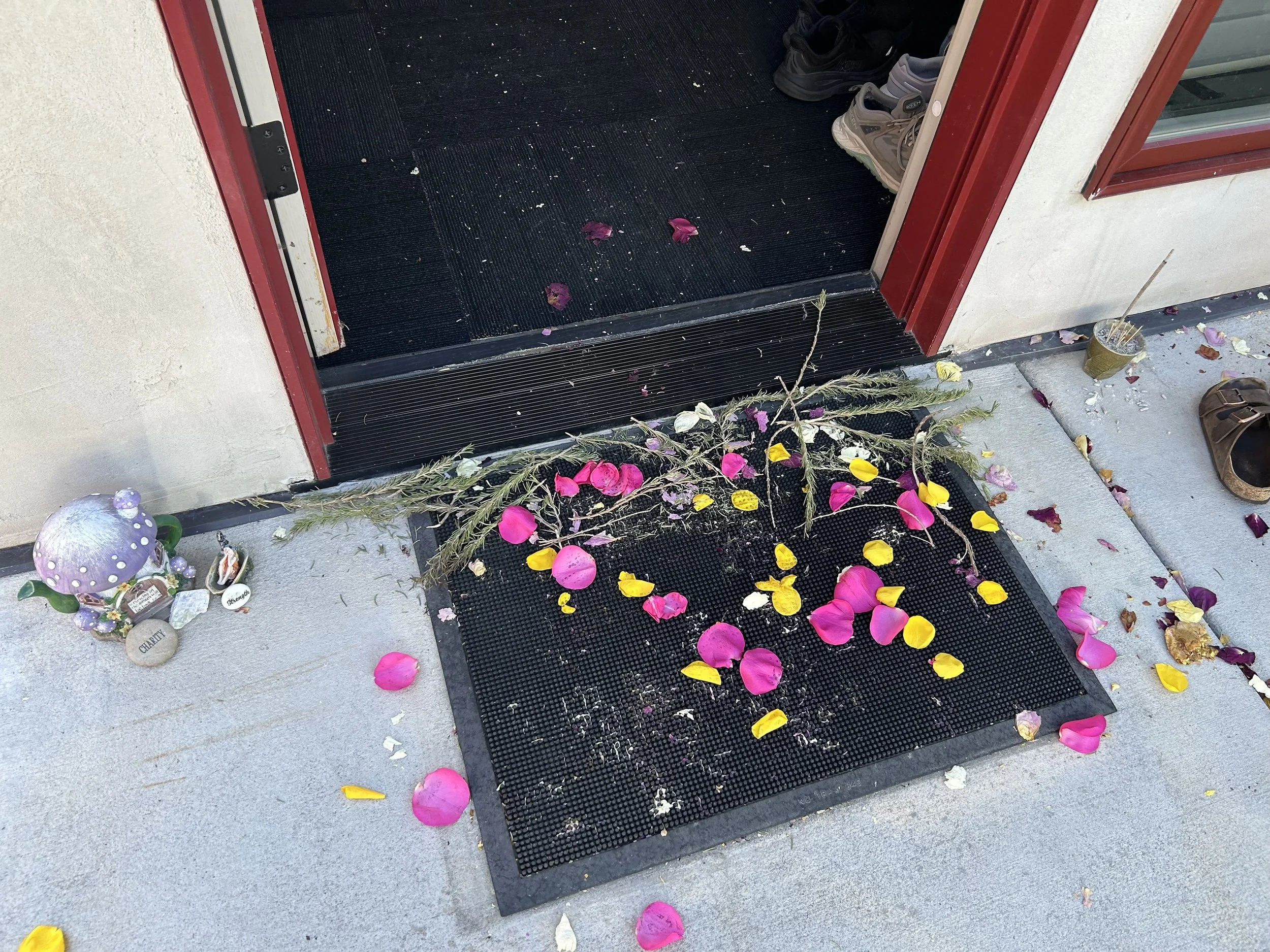
The entrance to our ritual space, adorned with rosemary and rose petals. Photos inside the ritual space were prohibited.
Okay, enough hedging. Here’s what we did:
First, we filled out applications, months in advance of the scheduled retreat. I have no idea of the criteria they used to determine who was invited to pay the retreat fee ($850, which did not include transportation or lodging or food – just minimal snacks) and make the trek to Salt Lake City, but I made the cut.
Then, we corresponded via a private sharing platform (Ruzuku), introducing ourselves and commenting on one another’s posts. We met via Zoom for a prep call two weeks ahead of our first retreat day. Some parameters were outlined: plan to bring ancestral photos and treasured and sacred symbols and objects for both the grief altar and the ancestral altar; know that photographs within the ritual space are prohibited; expect that we’ll gather during defined times over the course of the four days – keep the start time solid but know the end time may slide (“we respect our time, not clock time in this space”); consider leaving space before and after our scheduled sessions for replenishment because you’ll likely be depleted (TRUE – I slept so, so deeply from pure exhaustion every night after we met and there is no way I could have sat in a restaurant after the daylong processes); bring a journal and something to write with (my writing from the prompts that were offered was deep, cathartic, excavating); bring a yoga mat for some laying down practices (super helpful since the meeting room had a concrete floor).
On Friday evening, we met for 3.5 hours, and it was the most taxing emotionally and physically of all the days simply because of the intensity of the grief that was poured out into the room that evening. After settling into a circle with all 50 of us, we started with drumming and dancing – all of our sessions started this way. We always did somatic practices, a bit of breathwork, but more of an emphasis on rhythmic movement and vocalizing (it wasn’t singing so much as chanting – almost every “song” we were taught were sounds, not words – they often had meaning that was explained to us, but it felt primal to utter the sounds rather than recite words). But what was hardest was the sharing circle we did that first night after the leaders set the container (forgive me for this wording – see above about my aversion – but that’s sincerely what they did). One by one, we passed a microphone around the room, and each person shared one individual grief and one collective grief.
The entire weekend was rooted in Francis Weller’s work, the bulk of which is in The Wild Edge of Sorrow: Rituals and Renewal and Sacred Work of Grief. That book outlines the sacred gates of grief: 1) the truth that everything and everyone we love, we will lose; 2) the places within us that have not known love; 3) the sorrows of the world; 4) what we expected and did not receive; 5) ancestral sorrows; 6) the harm we have caused. I won’t recount the specifics of what people shared in that first circle out of respect for their privacy, but I will say that it gutted me. It ripped me right open, left me raw, and with tears and snot running down my face. And somehow, it didn’t take me under. I think that’s because of what Andrea Gibson once wrote: “even when the truth isn't hopeful, the telling of it is.”
So much of what we did the next day is a blur, blended together in a fuzzy memory. We were led through movement and vocalizing and breathwork practices. Look, I’m a hardcore intellectualizer. I’ve spent years living from the neck up, analyzing the world and myself from a safe distance, but I took to these practices like a fish to water. The emotional safety, the playful tenor, the skillful leadership – it all opened me up to access my body in a way I never have before.
We were led through writing prompts that invited us to give expression to our grief, the feral burdens that we all carried in with us. We paired up or got into groups of 3s or quads and we read aloud. The only response we were allowed to give others when we listened to their words was, “Thank you.” Not, “I’ve experienced something similar.” Not, “That makes me think of...” Not, “What I loved about your writing…” Just, “Thank you.” With reverence and a head nod, often soulful eye contact, and tears. That constraint saved me – it allowed me to find the courage to read aloud what I had written, to let my tears flow as I read what had emerged from me.
On Saturday, we had an ancestral ritual. Truthfully, this ritual didn’t grab me by the jugular the way Sunday’s grief ritual got me. I felt awe around the immensity of our individual and collective lineages, especially because of the symbols that our ritual leaders used to offer us that perspective. I had reverence for my own ancestors, who were represented in the objects I brought for the altar. And gazing upon others’ families in the fading and ancient photos humbled me. I was moved. I was affected, but it wasn’t profound. Yet, the proverb we were offered on this day landed hard for me: “a person becomes a person through other people.” In my writing after this ritual, I had some transmissions, some sweet encouragements that bathed me.
On Sunday, people wore their ceremonial clothes. The ritual leaders wore tribal clothing, two of them live in the Sacred Valley in Peru. Someone wore a Palestinian Keffiyeh. Another person had on a white jumpsuit that she called her Ghostbusters outfit. I just wore my sleeveless shirt because it was freaking hot in there, and I knew we would be dancing for a long time. We had been told to eat a hearty breakfast before we arrived at the retreat space because our lunch would be delayed until late afternoon after the ritual was done. People were invited to share their literal nighttime sleeping dreams as offerings for everyone, and there were some mic-drop moments.
Here’s the heart of the retreat, and I’m hesitating because I know what I write will fall short. First, get a sense of the physical configuration of the room. Almost all of the chairs were removed. We left a few because we knew we would get tired and need to rest. The altar in the center of the room was re-created along one wall, but we weren’t allowed to touch others’ sacred photos and objects, so everyone transported and settled their own. There were so, so many pillar glass candles (real, not electric), bunches and bunches of cut flowers, prayer shawls and fabric as the base. In front of the altar, six zabuton cushions rested on the floor, the altar up on tables, bowls of water in front of each cushion, Kleenex boxes abundantly splayed across the floor. Directly behind the six cushions was another set of zabutons for the supporters of the grievers, companions to lend energetic support. A beam was in the center of the room, dividing it in two, and the village (such a strange way to refer to the participants, but it was a fitting and important term) took up that other side of the room past the beam. A row of four drummers was on the village side, two of the leaders served as gatekeepers on either side of the last row of cushions to summon supporters, to watch the grievers if they needed something (puke bowl, anyone?), to dance with ferocity in a tone-setting way. We were taught a song (sounds, not words) that we chanted continuously for all 3 hours. We were told our bodies would know when to approach the altar to take a vacant spot or to be a support person for a griever. We were told to toss our snotty, tear-filled tissues in front of the altar – they would be gathered and burned later as would prayers that we wrote over the course of the weekend and left on the altar.
Here’s what I know: The village has its own life, its own voice, and I am part of it. My body knew exactly when to go to the altar (shockingly – see above about my analytical nature). It was a deep, deep honor to sit on the companion cushion. I loved everyone there. I have to write that part again: I was so in love with every person there. My heart: wide open. As grievers wailed, the villagers sang, our voices rising and swelling to match the volume of the wailing. As the grievers writhed, the villagers danced harder, not to drown out or eclipse, but to embrace.
There’s so much more: the rose petal adornment we received after the end of the ritual along with the rose spritz. The gifts that the leaders bestowed upon us on Monday just before we left (these were literal gifts, not just metaphorical) so that we could carry forth part of them. The poems that were read aloud. Mary Oliver. Rosemerry Wahtola Trommer. Stephen Levine. The term that one of the participants used to describe her state in the immediate aftermath of the grief ritual: holy dishevelment. The teachings that our leaders offered, including one that Alexandre said just before we left. This is a paraphrase, my attempt to recreate what he said: “We’ve all heard of the hero’s journey and felt its presence shape our culture. We’re now in the era of the journey of the village, the collective.” That landed hard in the room, like an elixir for all of our parched souls.
I’ve written so much, and there are still details and layers that will resurface in the coming days and months. I will likely write more as my own deep inner knowings emerge. Two things that I’ll end with:
This wasn’t a pristine or perfect experience, and Erin started the retreat by asking us to allow their imperfections to be part of the weekend. I could pick apart decisions they made, things they said, but those are rare and would take me to a petty space – just not worth it. I’d much rather be in love with them. There were participants who, at the end of the ritual and also at the weekend, expressed disappointment, even aloneness. At times, I found myself in some of the quicksand that all humans fall into: comparison, cringing at what I had shared (or held back), physical discomfort (dancing on a concrete floor in bare feet took a toll on my 60-year-old knees!). But I loved it all the more for its warts and foibles.
I have no relationship with any of these people, financial or personal, beyond what I’ve written here. I just love them and the work they’re doing in the world. So, know that I’m offering these links with this spirit: every single person in the world needs better pathways to identifying and expressing grief. So, if you want some of what I’ve described here, start with Francis Weller’s incredible book, The Wild Edge of Sorrow. Get on Erin and Carl’s mailing list. Also, Alyona and Alexandre’s mailing list. They’re not the only people who offer these retreats, so look at the Events page on Francis Weller’s website if you want to find others.